Peru Weather
When it comes to exploring the Andes, the best weather actually arrives during the Southern Hemisphere’s winter months, which align with the dry season. From April through mid-November, skies are clearer, rain is rare, and visibility is at its best—perfect conditions for admiring the dramatic landscapes and breathtaking views of Machu Picchu.
That said, the rainy season, from mid-November to March, also has its charm. While clouds and showers are more frequent, the valleys turn a vibrant green, and the trails are noticeably quieter, giving you the chance to enjoy the Sanctuary with fewer crowds. With some luck, you can still catch stunning weather between the showers.
In short, you can visit Machu Picchu year-round – each season offers its own rewards:
- Dry Season (Winter: April – November)
Clear skies, excellent visibility, drier conditions, but more visitors.
- Wet Season (Summer: November – March)
Lush, green scenery, fewer crowds, but more rain and reduced visibility.
How do I buy Tickets to Machu Picchu?
Machu Picchu is a UNESCO World Heritage site. To prevent overuse, only a set number of visitors are allowed each day. During high season (June to September and on certain public holidays) it can welcome 5,600 visitors. The rest of the year this number drops to 4,500.
Online tickets can often be sold out months in advance so we advice prospective visitors to research the various circuits on offer and to book their tickets even before you book your flights to Peru. At the time of writing 1,000 of the tickets available on any given day are sold onsite in Aguas Calientes 24 to 48 hours before entry. This does entail spending at least one night in Aguas Calientes and queuing for hours without the guarantee of securing a ticket. Not our option of choice if you can avoid it.
To purchase tickets online we recommend the official website of the Ministry of Culture (Boleto Machu Picchu https://tuboleto.cultura.pe/llaqta_machupicchu).
You can book a Machu Picchu Ticket that gives you a one-hour time slot within which to enter the Sanctuary. The first window is from 6:00 to 7:00 and the last window from 14:00 to 15:00. The Sanctuary closes at 17:30.
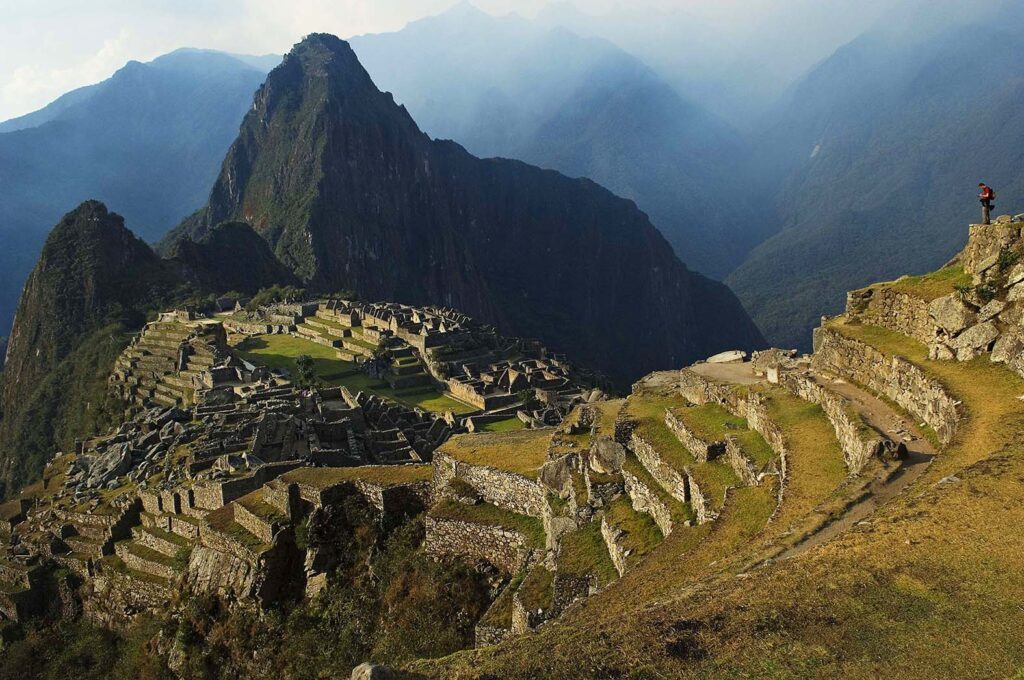
Which circuit to choose?
Circuit 1 – Panoramic views – This is the circuit of choice for those that want to take the Iconic pictures of the Inca Citadel with the Wayna Picchu peak in the background. It has four further sub-routes:
1A – You can hike up to Machu Picchu Mountain, from where you can site the snow-capped mountains of Salcantay and Pumasillo. The length of the circuit, round trip, is 3,8km and requires a certain level of fitness as it can be steep at times.
1B – Upper Terrace. This is the shortest route on offer, taking you to the observation terraces from which panoramic views of the city will offer you your instagrammable souvenirs. The route is 1,6km long.
1C – Intipunku Sun Gate. This route takes you to the official entrance to Machu Picchu from the Inca Trail, offering a different perspective for stunning pictures. The route is 3,4km long.
1D – Inka Bridge. Open only during the high season. This is a very picturesque walk along a winding path hugging a cliff and offering stunning views of the river valley below. At the end you reach an Inka Bridge made of stone and wood that led to the Qhapaq Ñan (Inca Trail) in the direction of Choquequirao, a sister city of Machu Picchu, which is about 4 days walk away. This route is 2,6km long and our preferred route of the four that comprise circuit 1.
The drawback of the Circuit 1 routes is that you can see stunning views of the citadel from afar, but you do not get to enter it. We therefore only advice this circuit if you are going to visit Machu Picchu over several days and will purchase other circuits to get a more comprehensive appreciation of this majestic site.
Circuit 2 – Cassical visit to the terraces in the center of the citadel and the entire urban area of Machu Picchu. It is divided in two sub routes:
2A-Starts in the agricultural sector from which you can observe the entire layout of the citadel. It then continues into the main temples, center square, sacred rock and water mirrors. The length of this route is 2,5 km.
2B-Starts in the agricultural sector, then proceeds from the observation terraces, ideal for panoramic pictures. Proceeds to the stone quarry from which much of the stone used to build the citadel was quarried. Then visits some of the main temples such as the sacred rock and the water mirrors. The length of this route is 2,7km and it is somewhat more physically demanding than 2A.
OUR CHOICE
Circuit 3 – Machu Picchu Royalty Comprised of four routes that take you to the most sacred parts of the citadel as well as to areas of limited access such as the Peak of Wayna Picchu. These routes tend to offer the most comprehensive access to the Citadel and we highly recommend doing one of them if your level of fitness allows as there is a lot of climbing.
3A-Waynapicchu Mountain Route. There are two entrance slots: 7am and 9 am. This route is not available during the rainy season (December to March). It starts in the agricultural area from where you can take some great panoramic shots. From here you can visit the most important buildings such as the Temple of the Sun, the Inka’s quarters, the temple of three windows and the ceremonial fountains. The path then leads uphill towards the peak of Wayna Picchu, a steep climb that will challenge your fear of heights. The views from Wayna Picchu are stunning, and well worth the hike. On your way back down, the route takes you past the temple of the Condor. The distance of this hike is 2,4 km and requires a high fitness level.
3B– Royal Route. Same as 3A, except without access to Wayna Picchu. This route is open all year round. The distance of the hike is roughly 1,3km.
3C- Great Cavern. Same as 3A, you start the climb to Wayna Picchu, but instead of climbing to the peak, you walk around the mountain to a cave with a shrine dedicated to the Moon. This route offers stunning views of the Urubamba river below. It is only open to the public during the high season (April to November) . The distance of the hike is roughly 3km and requires a high fitness level.
3D- Huchuy Picchu – Same as 3A, but instead of climbing to Wayna Picchu, you climb to a smaller peak, which is closer to the Citadel. It is less physically demanding and offers a close up view from a higher vantage point. A good option to take pictures from a different perspective. The distance of the hike is 1,7km and requires an intermediate fitness level.
Once you have purchased your entrance ticket to Machu Picchu you can plan on how to get there. So work your way backwards. Try to arrive in Aguas Calientes at least an hour before you are due to enter Machu Picchu, purchase your train ticket and purchase your bus ticket. Alternatively, hike to Machu Picchu through one of our recommended agencies and they will arrange all the logistics for you.
Where is Machu Picchu and How Do You Get There?
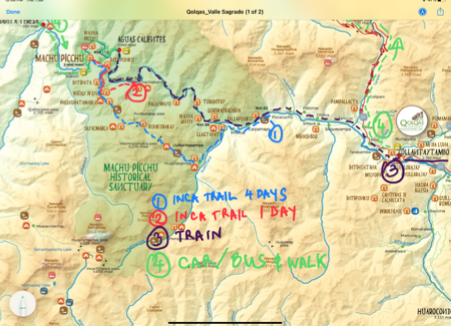
Planning a trip to Machu Picchu, the fabled Lost City of the Incas, involves navigating a few moving parts. Here’s what you need to know.
Recognized as one of the New Seven Wonders of the World, Machu Picchu is accessible from El Valle Sagrado (Cusco’s Sacred Valley). The citadel lies about 80 kilometers (50 miles) northwest of Cusco, overlooking the town of Aguas Calientes – also known as Machu Picchu Pueblo.
Its exact coordinates are 13°09′48″S, 72°32′44″W and hidden among misty peaks at 2,430 meters (7,970 feet) above sea level, the sanctuary is lower in altitude than Cusco by about 1,000 meters. This makes it an ideal first stop for travellers coming from sea level. You can explore the citadel’s mystical terraces and temples before heading back to Cusco, once your body has acclimatized to the thinner mountain air.
How do I get to Machu Picchu?
Machu Picchu can be reached on foot, by train, or by road. Below we elaborate on the various alternatives:
- Trekking (Traditional Inca Trail, 4 days/3 nights)
- Trekking (Shortened Inca Trail 1 day train + hike)
- Comfortable Option (Train 1.5 hours from Ollantaytambo)
- Budget Option (Bus / Taxi & walk along train track 5.5 hours)
- By bike <= Not an option
1. Trekking it – The Inca Trail:
Probably the most emblematic way to get to Machu Picchu is by Hiking the Inca Trail.
A four-day, three-night journey that starts a twenty-minute drive from Ollantaytambo at a suspension bridge over the Vilcanota River, next to km 82.
The trail itself is only 45km long, but there are big altitude differentials, particularly on day 2 when the highest pass exceeds 4,200 meters. Your lungs will suffer on the way up and your knees will suffer on the way down. Proper hiking shoes are a must and a good pair of walking sticks will come in handy. BUT make sure you equip them with rubber tips as otherwise you will not be able to take them on the trail. It is a memorable journey and one that we highly recommend.
Proper hiking shoes are a must and a good pair of walking sticks will come in handy. BUT make sure you equip them with rubber tips as otherwise you will not be able to take them on the trail. It is a memorable journey and one that we highly recommend.
The Trail has a limit of 500 visitors per day and each visitor requires a Trail permit and an officially certified guide for a group of up to eight people.
Two very professional operators are:
- Ecoinka – https://ecoinka.com/
- Explorandes – https://www.explorandes.com/
2. Our choice: Trekking (shortened route) The Inca Trail in a day
There is a shorter option for those who have limited time but want to experience the Inca Trail. This alternative can be done in one single day as follows:
Depart by train to Machu Picchu at 6:00 from Ollantaytambo to Km 104. Hike to the Citadel of Wiñay Wayna for three hours and stop for a picnic lunch. Walk for another hour and enter Machu Picchu via Inti Punku (Gate of the Sun) at around 13:00. Spend two to three hours exploring the Citadel just as the morning visitors are exiting, but before the afternoon shift arrives. Take the 18:00 train and be back in Ollantaytambo on time for a foot massage, a refreshment and a delicious meal. This is a rewarding compromise, which will give you a taste of the intensity of the Inca Trail and a visit to Machu Picchu without the need to take any luggage.
3. The Comfortable option: Train to Machu Picchu
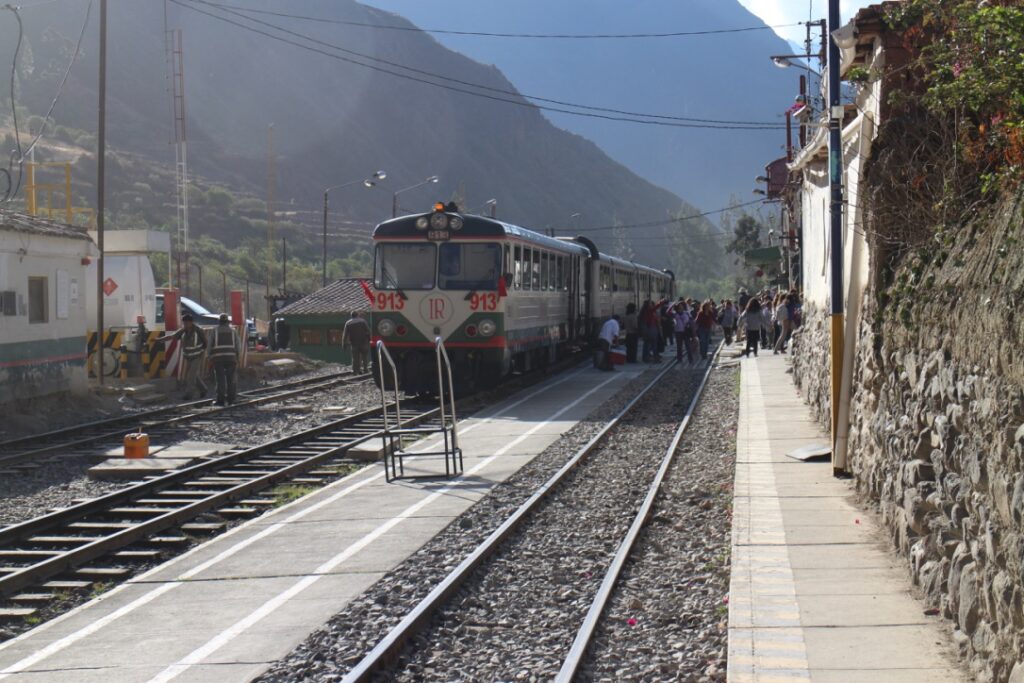
By far the most common (and practical) way to visit Machu Picchu is by train from Ollantaytambo to Aguas Calientes (Machu Picchu Pueblo). This trip can be conveniently done in a single day so you can use Ollantaytambo as a hub without the need of taking your luggage with you, plus accommodations in Ollantaytambo tend to be better value.
The earliest trains to Machu Picchu village leave Ollantaytambo at around 5:00 and arrive in Aguas Calientes at 6:30. The last returning before 22:00 and arriving in Ollantaytambo at 23:30.
Schedules do change depending on the season, so we recommend for you to check the websites of the two train operators in order to plan your journey.
Peru Rail – https://www.perurail.com/
Inca Rail – https://incarail.com/en
They both operate multiple services for a range of budgets, so take your time to look at the various options and decide which schedule/price combination suits you best. The reception at Las Qolqas Eco Resort can help you book your tickets, but bear in mind, during high season popular trains sell-out fast.
We would typically recommend leaving Ollantaytambo between 7:00 and 07:30, arriving in Aguas Calientes before 09:00. Taking the bus up to Machu Picchu by 10:00 (more on this to follow) and entering the citadel before 11:00.
After spending about three hours exploring the site, going down to Aguas Calientes by 14:00 and having lunch at El Indio Feliz or at Café Inkaterra
Both are excellent options, albeit at slightly different ends of the price scale.
We recommend for you to time your return train between 16:00 and 16:30 to reach Ollantaytambo by happy hour. Alternatively, you can take a more leisurely lunch and take an 18:00 return train for arrival by 20:00, but this will make your day rather long.
If you choose to visit Machu Picchu in the afternoon, then we advice you to leave Ollantaytambo at around 11:00 with a lunchbox to eat on the train. Arrive in Aguas Calientes by 12:30 and be up in Machu Picchu by 14:00. You will benefit from a sun which is lower on the horizon (hence cooler), warmer hues for your pictures (reddish glow), shadows providing better contrast for your pictures, better visibility and smaller crowds.
You would exit the sanctuary by 17:30 and have dinner at either of the two options mentioned earlier. If you choose this option, make sure to purchase your return train ticket well in advance as the last trains tend to sell-out quickly.
Getting up to Machu Picchu from Aguas Calientes:
Once you arrive by train to Aguas Calientes, you still need to get up to Machu Picchu. This is an altitude differential of roughly 400 meters. We recommend taking the bus, as the path up is rather steep and it criss-crosses the road taken by the buses, making it somewhat dangerous. Tickets can be purchased online at
Ticket Machu Picchu [https://www.ticketmachupicchu.com/book-bus-machu-picchu/] or at the ticket office in the center of town.
4. The Most Economical Option:
If you are on a budget, do not suffer from motion sickness and do not mind roughing it, then there is an option to travel by car from Ollantaytambo to the Power Station (hidroelectrica) near Machu Picchu.
The 148km trip is very scenic, but dangerous and not an option that should be considered by those who suffer from motion sickness, as this white-knuckle drive takes roughly three hours and fifteen minutes.
Once at the power station, travellers can reach Aguas Calientes by taking a 30-minute train (only one shift in the afternoon), or by doing a two-hour hike along the train tracks. If you choose this option, you should plan on spending the night in Aguas Calientes and visiting the Sanctuary the following morning.
Cars can be booked in the main square of Ollantaytambo, where you can join a minibus or book a private taxi.
Machu Picchu – Guides?
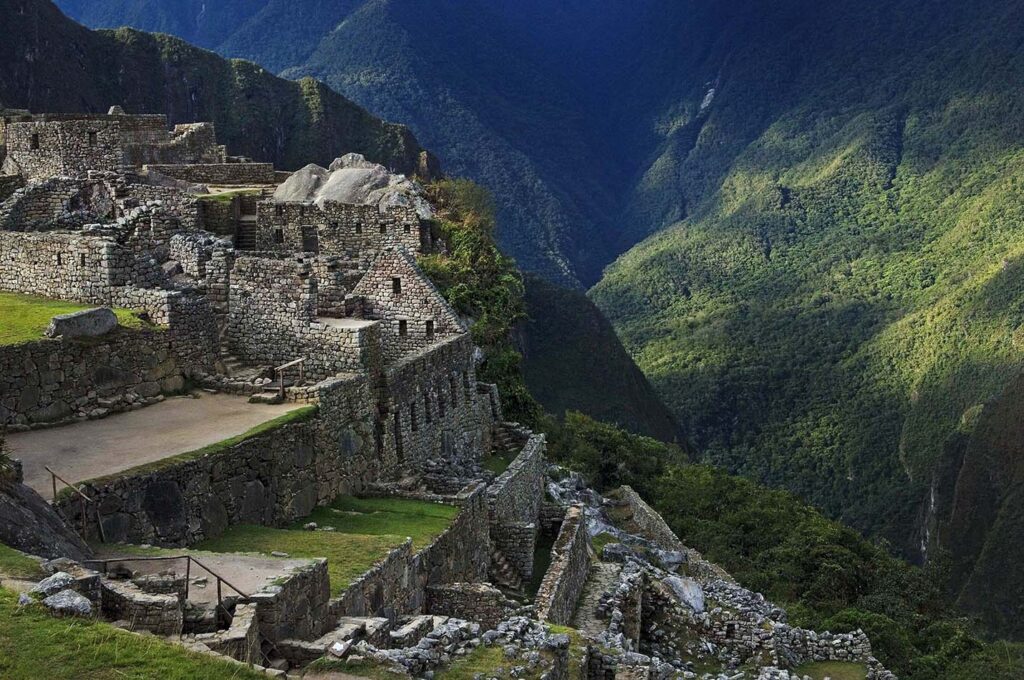
It is no longer compulsory for visitors to hire a guide to Machu Picchu. We recommend hiring one to better understand the Sanctuary’s layout, history, and mystique. There are officially guided tours in English and Spanish, or individual guides can be booked in English, Spanish, French and Portuguese.
A guide can be booked on Boleto Machu Picchu.
A word of caution: Reviews of the guiding standards can be mixed. At Las Qolqas Eco Resort we work with a panel of highly experienced guides, who are fluent in multiple languages.
Las Qolqas Activities Machu Picchu
There are several ways of reaching Machu Picchu, so read on to get our take on what route/means of transportation would suit you best.
How much does it cost to go to Machu Picchu?
The cost of your trip to Machu Picchu will depend on many factors:
- The mode of transportation
- The time of year
- The time slots you choose
- Group or individual guides
- Age / Citizenship / Student or not
- Accommodation in Aguas Calientes or Ollantaytambo
There are many moving parts and regulations. At Las Qolqas Eco Resort we will gladly arrange the most suitable combination for our guests based on availability. We advise our guests to book their trip as soon as they confirm their travel dates because of the finite number of slots available at the various stages of the journey.
A broad indication of the price ranges you can expect for the various components of your journey are below:
Entrance ticket to Machu Picchu
Prices vary. As of January 2026 Adults pay S/152 (+/- $ 45), Students pay S 77 ($ 23) and Minors pay S 70 ($ 21)
Citizens from Peru, Ecuador Bolivia and Colombia pay S/64 per adult and S/32 per student or child.
Guide for Machu Picchu:
Visitors must use the services of a guide when visiting Machu Picchu, at Boleto Machu Picchu
$ 60 for a group of up to 8 people
Accredited guides can also be arranged in advance from a variety of travel agents.
Transportation:
By Train to Machu Picchu there are two operators:
- Peru Rail has three service offerings.
Their basic train is the Expedition with a one-way ticket averaging $ 65
Their High-end train is the Vistadome, which averages $ 79 for one way.
Their Luxury train is the Hiram Bingham, which only goes from Cusco (Poroy Station) to Aguas Calientes. A one-way ticket will set you back approximately $ 500. All three trains will offer promotions from time to time.
- Inca Rail: They also offer various service levels starting with the Voyager at $ 60 for a one-way ticket and with prices rising in line with the size of the windows and service on the trains. They also offer promotions from time to time.
The bus from Aguas Calientes to Machu Picchu can be booked on Boleto Machu Picchu
Ticket $ 14 one-way for Peruvians, or $18 one-way for Foreigners.
The budget option: A bus ticket from Ollantaytambo to the Hydroelectric Power plant is roughly $ 18 (one-way) and $ 30 (round trip)
Whichever route you choose, you are bound to have a wonderful experience as this is a site, which should rightly be on most traveler’s bucket lists.
Enjoy your journey!
- Text and tips by Las Qolqas Eco Resort
- Photos by Walter Wust
Summary of Expenses to visit Machu Picchu
- Entrance Ticket: $ 21 to $ 45
- Guide: Starting at $ 60 for up to 8 people
- Bus to Sanctuary from Aguas Calientes: Starting at $ 14 one-way
- Train from Ollantaytambo: Starting at $ 60 one-way for foreigners
- Bus to Powerplant: Starting at $ 18 one-way
- Inca Trail 4 days: Starting at $ 850 per person
- Inca Trail 1 day: Starting at $ 275 per person